
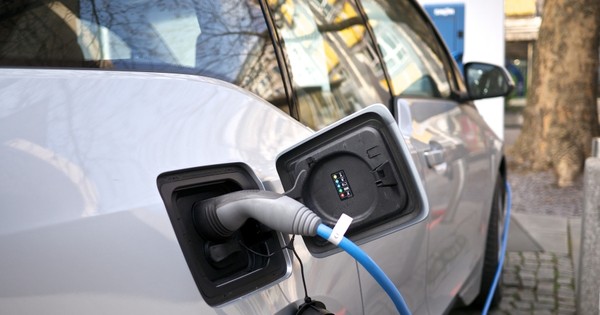
Above and beyond their ability to reduce local air pollution and carbon emissions, electric vehicles are also starting to make a lot of sense financially as well.

The technology could lead to cheaper hydrogen cars in the future.
By forcing light to go through a smaller gap than ever before, researchers have paved the way for computers based on light instead of electronics.
Researchers have developed a biocompatible ink for 3-D printing using living bacteria.

Unnatural DNA used to encode unnatural proteins, all in otherwise normal cells.

Danish firm has unveiled the ultra-sustainable Biological House, which was built with green building materials created out of agricultural residues.

The experiment has directly detected a sudden drop-off in the electrons hitting the satellite.

The Very Large Telescope in Chile has taken the deepest spectroscopic survey of space ever, with astronomers focusing on the Hubble Ultra Deep Field.

Forward has redesigned the primary care experience around data. Visits are holistic and not simply reactive to a specific complaint. Care is designed to catch the signs of chronic conditions.

The design evolution of Kuri, from prototype to consumer product, provides a fascinating glimpse into a new era of interaction between humans and increasingly sophisticated machines.

Copenhagen has a “huge, ambitious target” to reach zero carbon emissions by 2025.

Qantas recently announced it will operate the world’s first bio-fuel flight between the United States and Australia. The Los Angeles to Melbourne flight will take place early next year.

Google is officially off-setting 100% of its energy usage with either wind or solar power. The company signed contracts on three wind power plants in recent days.

MIT team designed an environmentally friendly city for the red planet that mimics a forest, with solar-powered dome tree habitats connected with roots, or tunnels.

SOURCE panels can be installed atop any building just like a standard photovoltaic, but harvests drinking water in addition to solar energy.


