

Since the mid-1990s, coral in the Great Barrier Reef has declined by more than 50%. The research spanned the entire 2,300 km of the Great Barrier Reef and found a disturbing loss at pretty much every level.

A SpaceX Falcon 9 rocket fired 60 more Starlink internet relay satellites into orbit Sunday from the Kennedy Space Center with another set awaiting launch Wednesday from the nearby Cape Canaveral Air Force Station.

In 2018, ExxonMobil announced its intention to reduce its methane emissions and gas burning. But newly leaked documents reveal that Exxon actually plans to increase its carbon production by 17% by the year 2025.

Being exposed to urban air pollution, particularly nitrogen dioxide (NO2), may make COVID-19 more deadly for some people.

Astronomers have found six galaxies lying around a supermassive black hole when the Universe was less than a billion years old. This is the first time such a close grouping has been seen so soon after the Big Bang.

The growing use of nitrogen fertilizers in the production of food worldwide is increasing atmospheric concentrations of nitrous oxide - a greenhouse gas 300 times more potent than CO2.

The Prize in Chemistry went to Emmanuelle Charpentier and Jennifer Doudna. The two researchers achieved fame in 2012 when they developed the revolutionary tool CRISPR-Cas9 to make gene editing easier.

The UN World Food Programme (WFP), which provides lifesaving food assistance to millions across the world - often in extremely dangerous and hard-to-access conditions - has been awarded the 2020 Nobel Peace Prize.

The 2020 Nobel Prize in Physics was awarded to Sir Roger Penrose and to Reinhard Genzel and Andrea Ghez for their discovery of the supermassive black hole at the Center of the Milky Way.

It looks like we may have to update our theories on how stars and planets form in new solar systems. According to a new study, it looks like planets and stars can form and grow up together.
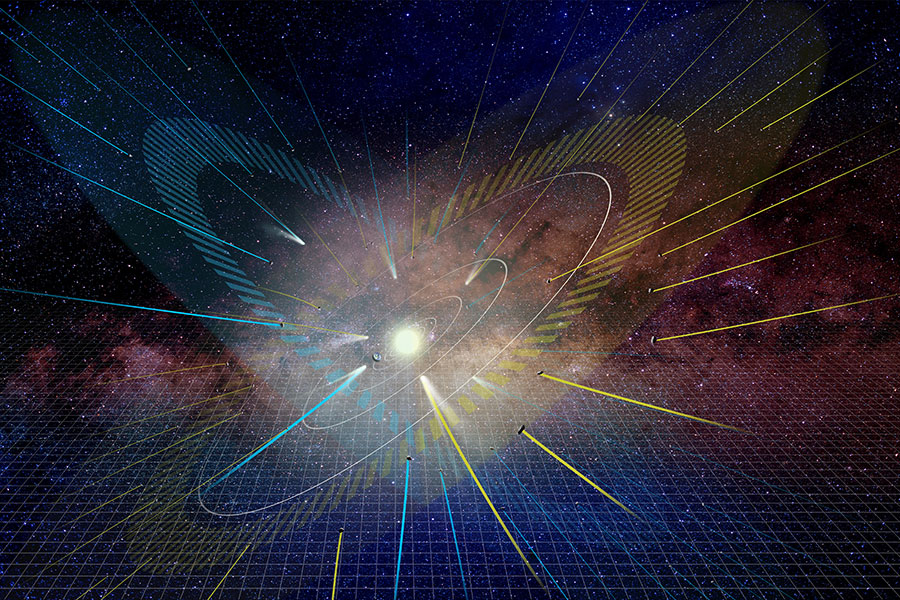
Almost all the objects orbiting the sun live in a particular plane. But a recent analysis of long-period comets reveals a second plane and it may be populated with comets.

"For too many decades, we have allowed cars to pollute the air that our children and families breathe. Californians shouldn’t have to worry if our cars are giving our kids asthma", the governor has announced.

U.S. physicists has successfully developed a circuit capable of capturing graphene's thermal motion and converting it into an electrical current. This could provide clean, limitless, low-voltage power for small devices.

After experiencing trauma or severe stress, some people develop an abnormal stress response or chronic stress. This increases the risk of developing other diseases such as depression and anxiety.

The researchers' new concept demonstrates an unprecedented receiver sensitivity of just one photon-per-information bit at a data rate of 10 gigabits per second.


