
Jupiter's melting heart sheds light on mysterious exoplanet
Could there really be billions of habitable worlds in our galaxy? Learn whether there could really be billions of habitable worlds in our galaxy.
Seven years ago, astronomers boggled when they found the first runaway star flying out of our galaxy at a speed of 1.5 million miles per hour. The discovery intrigued theorists, who wondered: If a star can get tossed outward at such an extreme velocity, could the same thing happen to planets?

Astronomers have put forward a new theory about why black holes become so hugely massive -- claiming some of them have no
The leading edge of the first of two major coronal mass ejections will reach Earth at about 1:25 AM EST on the morning of March 8 (plus or minus 7 hours). Such a CME could result in a severe geomagnetic storm, causing aurora at low latitudes, with possible disruption to high frequency radio communication, global positioning systems (GPS), and power grids.
Los Alamos National Laboratory scientists and an international research team have announced discovery of molecular oxygen ions (O2+) in the upper-most atmosphere of Dione, one of the 62 known moons orbiting the ringed planet. The research appeared recently in Geophysical Research Letters and was made possible via instruments aboard NASA's Cassini spacecraft, which was launched in 1997.

In the grand scheme of the solar system, Venus and Earth are almost the same distance from the sun. Yet the planets differ dramatically: Venus is some 100 times hotter than Earth and its days more than 200 times longer. The atmosphere on Venus is so thick that the longest any spacecraft has survived on its surface before being crushed is a little over two hours. There's another difference, too. Earth has a magnetic field and Venus does not -- a crucial distinction when assessing the effects of the sun on each planet.

For the first time, buckyballs have been discovered in the cosmos in a solid form in the vicinity of a binary star system 6,500 light-years away.
Nearly 13.7 billion years ago, the universe was made of only hydrogen, helium and traces of lithium — byproducts of the Big Bang. Some 300 million years later, the very first stars emerged, creating additional chemical elements throughout the universe. Since then, giant stellar explosions, or supernovas, have given rise to carbon, oxygen, iron and the rest of the 94 naturally occurring elements of the periodic table.

ESO’s Very Large Telescope has delivered the most detailed infrared image of the Carina Nebula stellar nursery taken so far. Many previously hidden features, scattered across a spectacular celestial landscape of gas, dust and young stars, have emerged. This is one of the most dramatic images ever created by the VLT.

Leaner, greener flying machines for the year 2025 are on the drawing boards of three industry teams under contract to the NASA Aeronautics Research Mission Directorate

NASA's Interstellar Boundary Explorer (IBEX) has captured the best and most complete glimpse yet of what lies beyond the solar system.
As the Earth's magnetic field begins to calm after several days of intense geomagnetic activity, the NOAA has announced that we experienced the largest solar radiation storm since 2003.
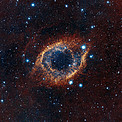
ESO’s VISTA telescope, at the Paranal Observatory in Chile, has captured a striking new image of the Helix Nebula. This picture, taken in infrared light, reveals strands of cold nebular gas that are invisible in images taken in visible light, as well as bringing to light a rich background of stars and galaxies.

NASA's Hubble Space Telescope has looked deep into the distant universe and detected the feeble glow of a star that exploded more than 9 billion years ago. The sighting is the first finding of an ambitious survey that will help astronomers place better constraints on the nature of dark energy, the mysterious repulsive force that is causing the universe to fly apart ever faster.


