
Could there really be billions of habitable worlds in our galaxy? Learn whether there could really be billions of habitable worlds in our galaxy.
Seven years ago, astronomers boggled when they found the first runaway star flying out of our galaxy at a speed of 1.5 million miles per hour. The discovery intrigued theorists, who wondered: If a star can get tossed outward at such an extreme velocity, could the same thing happen to planets?
Astronomers have put forward a new theory about why black holes become so hugely massive -- claiming some of them have no

In the grand scheme of the solar system, Venus and Earth are almost the same distance from the sun. Yet the planets differ dramatically: Venus is some 100 times hotter than Earth and its days more than 200 times longer. The atmosphere on Venus is so thick that the longest any spacecraft has survived on its surface before being crushed is a little over two hours. There's another difference, too. Earth has a magnetic field and Venus does not -- a crucial distinction when assessing the effects of the sun on each planet.
For the first time, buckyballs have been discovered in the cosmos in a solid form in the vicinity of a binary star system 6,500 light-years away.

ESO’s Very Large Telescope has delivered the most detailed infrared image of the Carina Nebula stellar nursery taken so far. Many previously hidden features, scattered across a spectacular celestial landscape of gas, dust and young stars, have emerged. This is one of the most dramatic images ever created by the VLT.
Leaner, greener flying machines for the year 2025 are on the drawing boards of three industry teams under contract to the NASA Aeronautics Research Mission Directorate

NASA's Interstellar Boundary Explorer (IBEX) has captured the best and most complete glimpse yet of what lies beyond the solar system.

Physicists have built an accurate model of part of the solar system inside a single atom. Scientists have shown that they could make an electron orbit the atomic nucleus in the same way that Jupiter

As the Earth's magnetic field begins to calm after several days of intense geomagnetic activity, the NOAA has announced that we experienced the largest solar radiation storm since 2003.
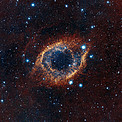
ESO’s VISTA telescope, at the Paranal Observatory in Chile, has captured a striking new image of the Helix Nebula. This picture, taken in infrared light, reveals strands of cold nebular gas that are invisible in images taken in visible light, as well as bringing to light a rich background of stars and galaxies.

NASA's Hubble Space Telescope has looked deep into the distant universe and detected the feeble glow of a star that exploded more than 9 billion years ago. The sighting is the first finding of an ambitious survey that will help astronomers place better constraints on the nature of dark energy, the mysterious repulsive force that is causing the universe to fly apart ever faster.

You may have heard by now about the 100 Year Starship project, a new research initiative to develop the technology required to send a manned mission to another star. The project is jointly sponsored by NASA and the Defense Advanced Research Projects Agency (DARPA). It will take that long just to make such a trip feasible, hence the name. So we’re a long ways off from naming any crew members or a starship captain, but the project itself does have a new leader, a former astronaut.

(PhysOrg.com) -- For the first time, astronomers have mapped dark matter on the largest scale ever observed. The results, presented by Dr Catherine Heymans of the University of Edinburgh, Scotland, and Associate Professor Ludovic Van Waerbeke of the University of British Columbia, Vancouver, Canada, are being presented today to the American Astronomical Society meeting in Austin, Texas. Their findings reveal a Universe comprised of an intricate cosmic web of dark matter and galaxies that spans more than one billion light years.
On Wednesday, Jan. 18, astronomers, physicists and scientists from related fields will convene in Tucson, Ariz. from across the world to discuss an endeavor that only a few years ago would have been regarded as nothing less than outrageous. The conference is organized by Dimitrios Psaltis, an associate professor of astrophysics at the University of Arizona


