

The Daniel K. Inouye Solar Telescope (DKIST) recently took its first image which reveals an unprecedented level of details. These images provide a close-up view of the turbulent plasma arranged in a pattern of cell-like structures.

A meteorite that crashed into Australia back in 1969 contains interstellar stardust dating back some 7 billion years, predating the formation of Earth by 2.5 billion years. The discovery offers a snapshot of the conditions that existed before our solar system.

A team of astronomers has created the first global map of Titan by using the Cassini probe's over 100 fly-bys to stitch together both imagery and radar measurements.
Astronomers spotted a magnetic explosion on the surface of the sun unlike anything they've ever seen before. Although it was initially theorized about 15 years ago, this was their first direct observation of it thanks to NASA's Solar Dynamics Observatory.
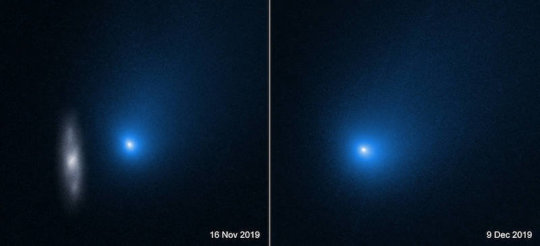
Comet 2I/Borisov is only the second interstellar object known to have passed through the solar system. This mysterious visitor from the depths of space is the first identified comet to arrive here from another star.

Since its 2018 launch, NASA's Parker Solar Probe (record-holder for closest-ever spacecraft to the Sun) has finished three of 24 planned passes through never-before-explored parts of the Sun's atmosphere.

Hygiea is located in the main asteroid belt between Mars and Jupiter and is the fourth largest object in the main asteroid belt. Now, a new telescopic survey suggests Hygiea is a dwarf planet, due to its surprisingly spherical shape.

According to an international team of scientists, the lake that was present in Gale Crater over 3 billion years ago underwent a drying episode, potentially linked to the global drying of Mars.

Scientists have found that the pressure at the edge of the solar system is greater than expected after analyzing data collected by NASA's Voyager spacecraft—the only objects to have traveled to interstellar space.

A team of German scientists recently examined data gathered by the Cassini orbiter around Enceladus’ southern polar region and found was evidence of organic signatures that could be the building blocks for amino acids.

According to new study by a team of NASA scientists, Venus would have been able to maintain stable temperatures – from a low of 20 °C (68 °F) to a high of 50 °C (122 °F) – for about three billion years.

India launched an ambitious robotic lunar mission named Chandrayaan 2 on Monday, targeting a touchdown near the lunar south pole on 6 September. The Chandrayaan 2 mission is India’s most daring space project to date.

Two telescopes have measured the faint heat from the main, or epsilon ring, of Uranus, enabling astronomers for the first time to determine its temperature: a cool 77 Kelvin.

New research by a team of UK scientists has located the site of the massive impact that took place in Scotland 1.2 billion years ago. Roughly one billion years ago, Earth experienced a higher rate of meteorite impact than it does today.

A mysterious large mass of material has been discovered beneath the largest crater in our solar system - the Moon's South Pole - Aitken basin and may contain metal from the asteroid that crashed into the Moon and formed the crater.


