

The Juno spacecraft orbiting Jupiter has discovered an FM radio signal coming from the moon Ganymede. The find is a first-time detection from the moon. The signal is of natural origin.

A submarine mission to Saturn’s largest moon has long been under discussion. If such a mission was ever launched, it would have plenty of room to operate, because Titan’s largest sea, Kraken Mare, is likely more than 300 m deep.

Since 2019, NASA's InSight's probe, called the “mole,” has been attempting to burrow into the Martian surface. Martian soil’s tendency to clump deprived the mole of the friction it needs to hammer itself to a sufficient depth.

The current tilt of Saturn's rotation axis is caused by the migration of its satellites, and especially by that of its largest moon, Titan. Titan and the other moons are moving away from Saturn much faster than it had been previously estimated.

Three to four billion years ago, Mars did in fact have running rivers of water. Now, scientists have mapped out an entire ancient river system.

Astronomers using NASA's Hubble Space Telescope watched a mysterious dark vortex on Neptune (a storm, which is wider than the Atlantic Ocean) abruptly steer away from a likely death on the giant blue planet.

Researchers have discovered a new superhighway network to travel through the Solar System much faster than was previously possible. They could be used to send spacecraft to the far reaches of our planetary system.

China launched an ambitious mission on Tuesday to bring back rocks and debris from the moon’s surface for the first time in more than 40 years – an undertaking that could boost human understanding of the moon and solar system.

New work reveals the likely original locations of Saturn and Jupiter. These findings refine our understanding of the Solar System's unusual architecture, including the ejection of an additional planet between Saturn and Uranus.

NASA scientists identified a molecule in Titan’s atmosphere that has never been detected in any other atmosphere - cyclopropenylidene, or C3H2. This simple molecule may be a precursor to possible life on Titan.
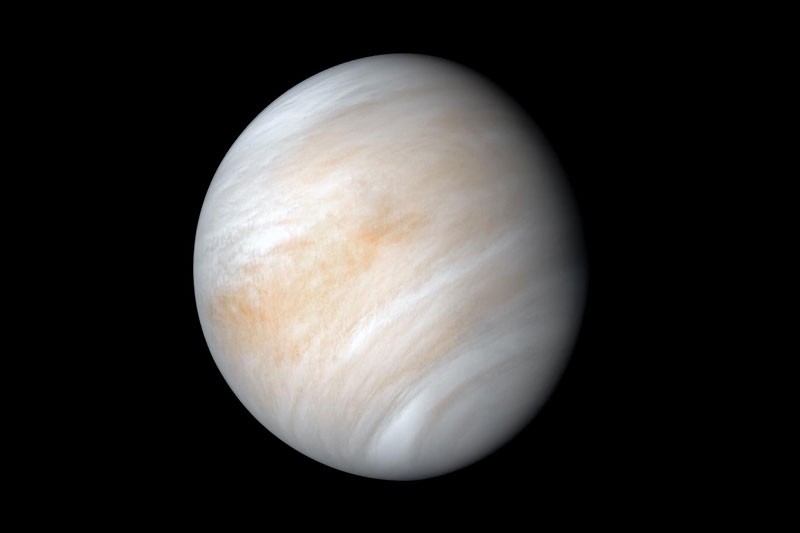
A team of researchers claims they've discovered the amino acid glycine in Venus' atmosphere. There are about 500 known amino acids, but only 20 are present in the genetic code. Glycine is the simplest of them.
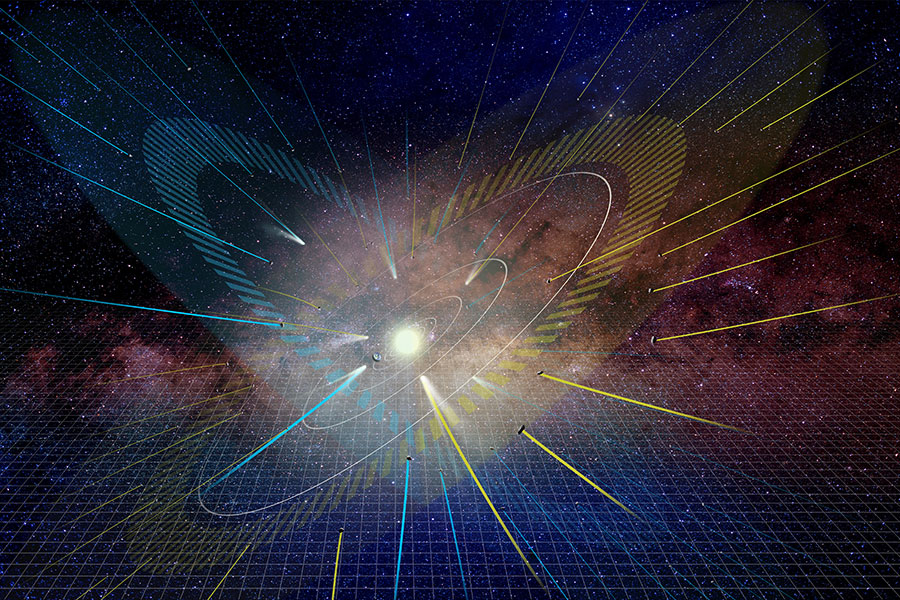
Almost all the objects orbiting the sun live in a particular plane. But a recent analysis of long-period comets reveals a second plane and it may be populated with comets.

An international team of scientists have recently found the abundances of phosphine in the Venusian cloud decks. It might - just might - be a biosignature.

In recent years, the confirmed number of Jovian moons has risen to 79. Now, a new study says that there may be 600 small irregular moons orbiting Jupiter.

Researchers have found what may be remnants of the solar system’s largest impact structure, ancient concentric troughs that extend across almost the entire surface of Jupiter’s moon Ganymede.


