
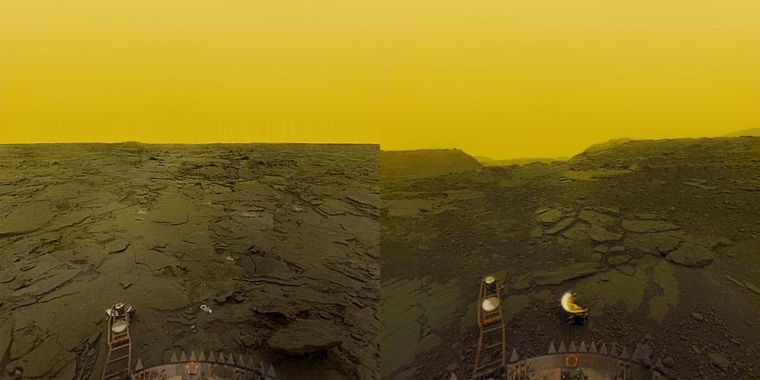
Over the last few years electronics based on the semiconductor silicon carbide (SiC) have started to mature. Those properties make it a very suitable candidate for computing on Venus.

Using the Akatsuki spacecraft, Japanese scientists have detected a large, bow-shaped anomaly in the upper atmosphere of Venus. Strangely, the 6,200-mile-long structure is refusing to budge despite the 225 mile-per-hour winds that surround it.

Scientists believe Venus was once Earth-like. How is this possible and what caused the planet to turn toxic?

Earlier in its history, the second planet from the sun may have had a liquid water ocean and temperatures suitable for life, a new study shows.
Astronomers have found a rocky planet orbiting a small star that is within easy telescope views from Earth.
In the grand scheme of the solar system, Venus and Earth are almost the same distance from the sun. Yet the planets differ dramatically: Venus is some 100 times hotter than Earth and its days more than 200 times longer. The atmosphere on Venus is so thick that the longest any spacecraft has survived on its surface before being crushed is a little over two hours. There's another difference, too. Earth has a magnetic field and Venus does not -- a crucial distinction when assessing the effects of the sun on each planet.
Lightning sprites are out-of-this-world: 'sprites' predicted in atmospheres of Jupiter, Saturn and Venus


