

A few years ago, researchers from Germany and Japan were able to simulate one percent of human brain activity for a single second. It took the processing power of one of the world’s most powerful supercomputers to make that happen.

The supercomputer can be compared to the western cowboys that tamed wild horses, also called Wranglers, because the computer is capable of taming big data.

2015 was the year everyone started making plans, laying groundwork, and building the infrastructure for the day when all our devices are connected.

The debate about preventing the Singularity; Artificial Intelligence and Climate Change; Proof that the Singularity will occur by 2030

Engineers have successfully married electrons and photons within a single-chip microprocessor, a landmark development that opens the door to ultrafast, low-power data crunching.

Processors using quantum mechanics are reportedly achieving much greater problem-solving speed.

US scientists create a computer model that enables computers to recognise and draw simple alphabet symbols that are indistinguishable from those created by humans.

Tesla Motors Inc Chief Executive Officer Elon Musk and other prominent tech executives are pouring $1 billion into a non-profit aimed at creating artificial intelligence that augments humans’ capabilities, rather than making them obsolete.

Google has been sharing more details about its quantum computing project, which it runs in partnership with NASA.

How tiny can a computer get and what can it do? Digital sensors are already traveling inside human bodies. Will shrinking sizes eventually do away with the bulky devices we use now?

In the race to build the first functional quantum computer, Australian researchers at the University of NSW find coding possible in silicon

NASA today sent out invitations to journalists for a tour of its Quantum Artificial Intelligence Laboratory, a joint project with NASA, Google, and the Universities Space Research Association located at NASA Ames Research Center in Silicon Valley.

A new machine-learning simulation system promises cosmologists an expanded suite of galaxy models -- a necessary first step to developing more accurate and relevant insights into the formation of the universe.

Quantum physics theory has an odd but fundamental quirk: atoms in a quantum state aren't supposed to move as long as you're measuring them. It sounds preposterous, but Cornell University researchers have just demonstrated that it's real.
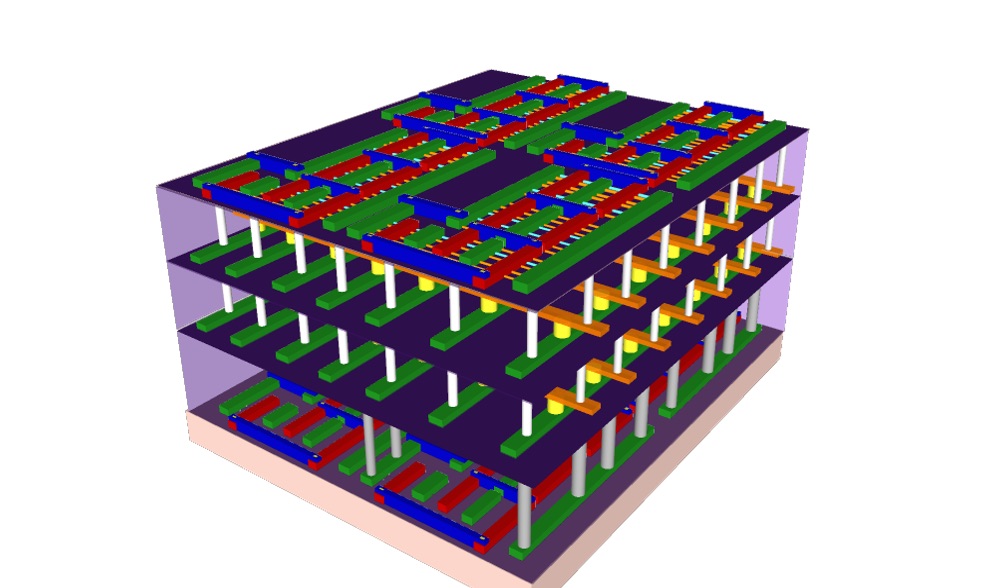
A new computer chip that uses carbon nanotubes and builds connections in 3D could be 1,000 times faster than current technology.


