
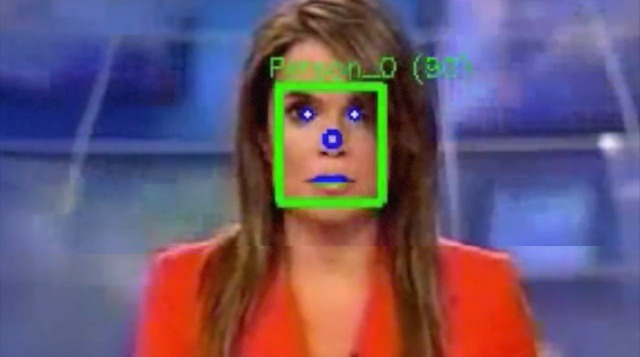
A new video shows off the creepy, emerging world of robot vision.

Using a Sony Move controller and pico projectors, two British studios film a Holodeck-like experience, without post-production tricks.

(PhysOrg.com) -- A research project at Microsoft Research Cambridge has brought forth a prototype called Holodesk, which lets you manipulate virtual objects with your hand. You literally "get your hands on" the virtual display. According to the official description from its creators, there is at work a "novel real-time algorithm for representing hands and other physical objects" allowing physically realistic interaction between real and virtual 3-D objects.

A new type of integrated circuit may be so energy efficient that it could run simply by harvesting energy from the environment.

A new computer hardware prototyping board, designed in Crete, has been successfully tested. Sixty four copies of it are currently being built, to be subsequently interconnected to each other, in order to make a prototype of a future architecture -- a half-a-thousand-processor parallel

(PhysOrg.com) -- For the first time, scientists at IBM Research have demonstrated that a relatively new memory technology, known as phase-change memory (PCM), can reliably store multiple data bits per cell over extended periods of time. This significant improvement advances the development of low-cost, faster and more durable memory applications for consumer devices, including mobile phones and cloud storage, as well as high-performance applications, such as enterprise data storage.


(PhysOrg.com) -- "Human beings are more or less like a computer," Jian-Jun Shu tells PhysOrg.com. "We do computing work, and our DNA can be used in computing operations." Shu is a professor at the School of Mechanical and Aerospace Engineering at the Nanyang Technical University in Singapore. "For some problems, DNA-based computing could replace silicon-based computing, offering many advantages."

The Aero Train is a free-flying, robotic train-plain that levitates on a cushion of air.

(PhysOrg.com) -- Any fan of Star Trek knows about the joys of the holodeck. The idea of a 3D, 360-degree immersive digital environment, projected on demand, is an enticing one that has thus far been confined to the silver screen, but technologies are emerging that just may make this possible. In 2008 Physorg reported on a 3D fog display on a room-sized scale, but it could not give a 360 degree experience. New developments in this area may make this possible at some point in the future.

Magnetic Random Access Memories (MRAM) are the most important new modules on the market of computer storage devices. Like the well known USB-sticks, they store information into static memory, but MRAM offer short access times and unlimited writing properties. Commercial MRAMs have been on the market since 2005. They are, however, still slower than the competitors they have among the volatile storage media.

Touchscreens may not be all they

Scientists have discovered that if you "prune" a computer chip

A prototype implantable eye pressure monitor for glaucoma patients is believed to contain the first complete millimeter-scale computing system.

Volunteers experienced the virtual bodies as if they were their own, with possible applications in computer games or to transport people digitally to other locations


