

Researchers have announced breakthroughs in the development of tunneling field effect transistors, a semiconductor technology that takes advantage of the quirky behavior of electrons at the quantum level.

Inspired by a toy, the

Using breakthrough techniques on some of the world

(PhysOrg.com) -- Since its discovery in 2004, graphene -- sheets of carbon an atom thick -- has sparked a flurry of research into the nanomaterial

Google has confirmed the existence of a project to build glasses with a heads- …
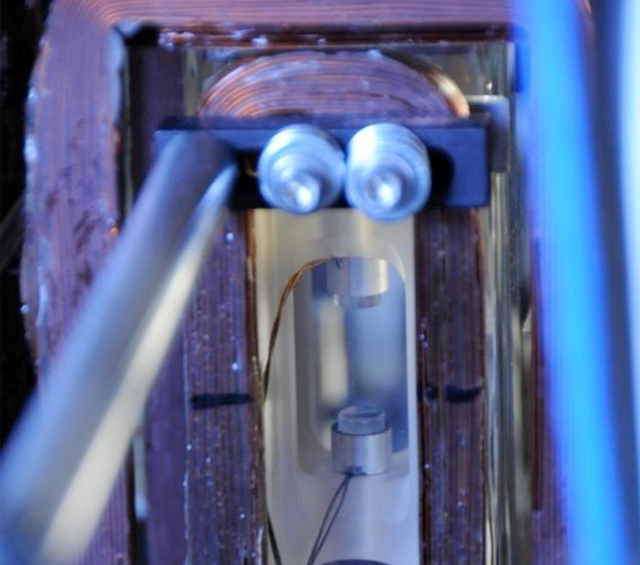
Ordinary lasers emit photons that have nearly identical frequencies, but for …
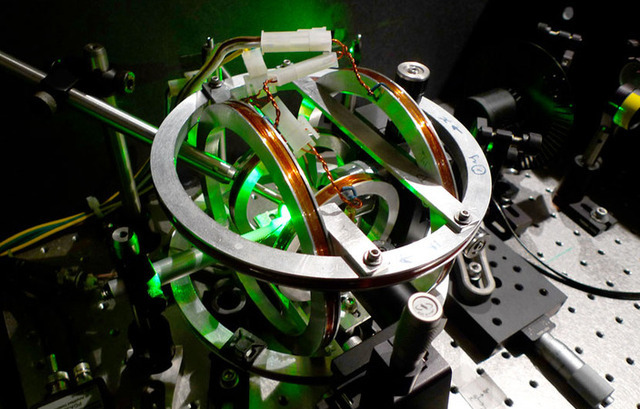
Scientist show how to make atoms swing to the beat (frequency).

(PhysOrg.com) -- UCLA researchers are now able to peer deep within the world

In the continual quest for better thermoelectric materials -- which convert heat into electricity and vice versa -- researchers have identified a liquid-like compound whose properties give it the potential to be even more efficient than traditional thermoelectrics.

The tiny, high-speed computer chips found in every modern electronic device bear little resemblance to their bulky, slow ancestors of decades ago. Different materials, new designs and new production techniques have ensured successive generations of integrated circuits offer ever more performance at lower cost.

Scientists have provided the first experimental determination of the pathways by which electrical charge is transported from molecule-to-molecule in an organic thin film. These results also show how such organic films can be chemically modified to improve conductance for superior organic electronics.

Researchers have developed a unique way to create full-color holograms with the aid of surface plasmons.

Printing three dimensional objects with incredibly fine details is now possible using "two-photon lithography". With this technology, tiny structures on a nanometer scale can be fabricated. Researchers at the Vienna University of Technology (TU Vienna) have now made a major breakthrough in speeding up this printing technique: The high-precision-3D-printer at TU Vienna is orders of magnitude faster than similar devices (see video). This opens up completely new areas of application, such as in medicine.

(PhysOrg.com) -- A group of scientists led by researchers from the University of Rochester and North Carolina State University have for the first time sent a message using a beam of neutrinos – nearly massless particles that travel at almost the speed of light. The message was sent through 240 meters of stone and said simply, "Neutrino."

Blisteringly fast Internet speeds, more robust connections and a big increase in network capacity at little extra cost, even in rural areas? It


