
It's about 660 million times as massive as our sun, and a cloud of gas circles it at about 1.1 million mph. This supermassive black hole sits at the center of a galaxy dubbed NGC 1332, which is 73 million light years from Earth.
Astronomers have discovered the second-strongest merger shock in clusters of galaxies ever observed.

The capture of a burst of high-energy neutrinos from a far-off galaxy heralds a new era in astrophysics.

Three colliding spiral galaxies 1.8 billion light years from Earth have produced a monster black hole weighing in at 3 billion times the mass of the Sun
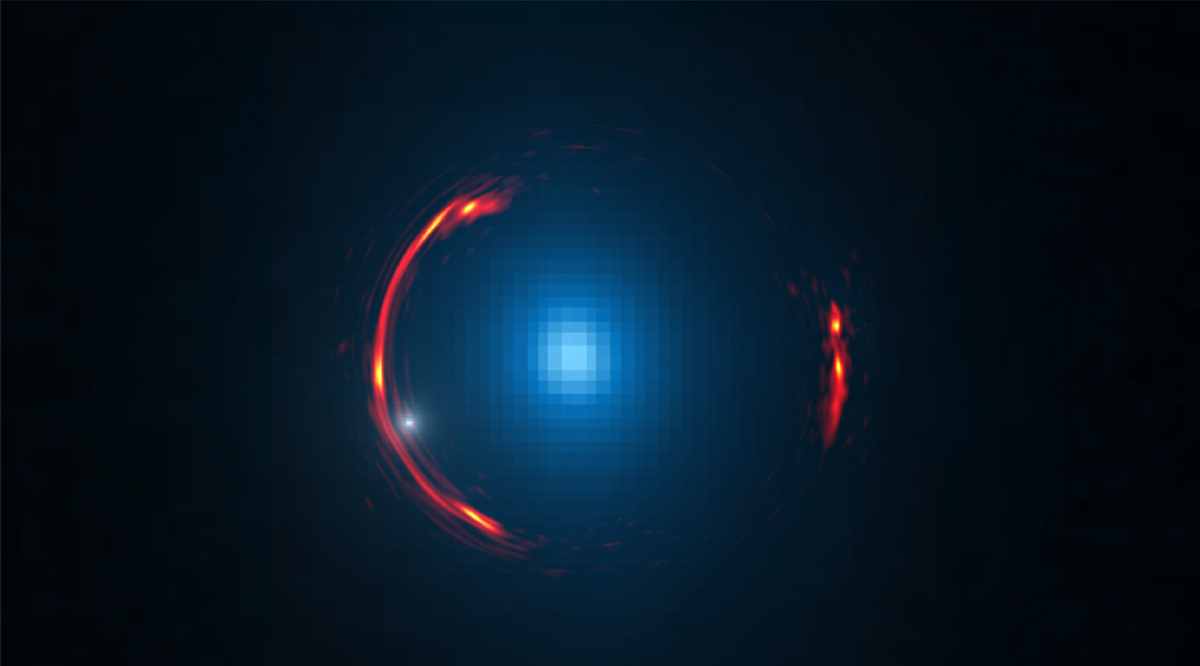
Subtle distortions hidden in ALMA’s stunning image of the gravitational lens SDP.81 are telltale signs that a dwarf dark galaxy is lurking in the halo of a much larger galaxy nearly 4 billion light-years away. This discovery paves the way for ALMA to find many more such objects and could help astronomers address important questions on the nature of dark matter.In 2014, as part of ALMA’s Long Baseline Campaign, astronomers studied a variety of astronomical objects to test the telescope's new, high-resolution capabilities.

Astronomers find a monster black hole 17 billion times more massive than the sun, raising suspicions supermassive black holes may be more common than first thought.

When worlds collide, literally.

Astronomers report that they have observed the most luminous galaxies ever seen in the Universe, objects so bright that established descriptors such as 'ultra-' and 'hyper-luminous' used to describe previously brightest known galaxies don't even come close.

Research has found new persuasive evidence that could help solve a longstanding mystery in astrophysics: why did the pace of star formation in the universe slow down some 11 billion years ago?

Alien rays from outer space, which pass through our bodies every second of every day, have been traced to their source – a super-massive black hole that lies at the heart of our home galaxy, the Milky Way, German and Australian scientists have discovered.

A spectacular image of the Milky Way has been released to mark the completion of the APEX Telescope Large Area Survey of the Galaxy (ATLASGAL).
New Hubble telescope observations suggest that a high-velocity gas cloud was launched from the outer regions of our own galaxy around 70 million years ago. Now, the cloud is on a return collision course and is expected to plow into the Milky Way's disk in about 30 million years.

Observations from ESO telescopes provide crucial third dimension in probe of Universe's dark side. ESO telescopes have provided an international team of astronomers with the gift of the

Physicists have firmed up a theoretical limit on the mass of a black hole by figuring out when it will disrupt the disc that feeds it.
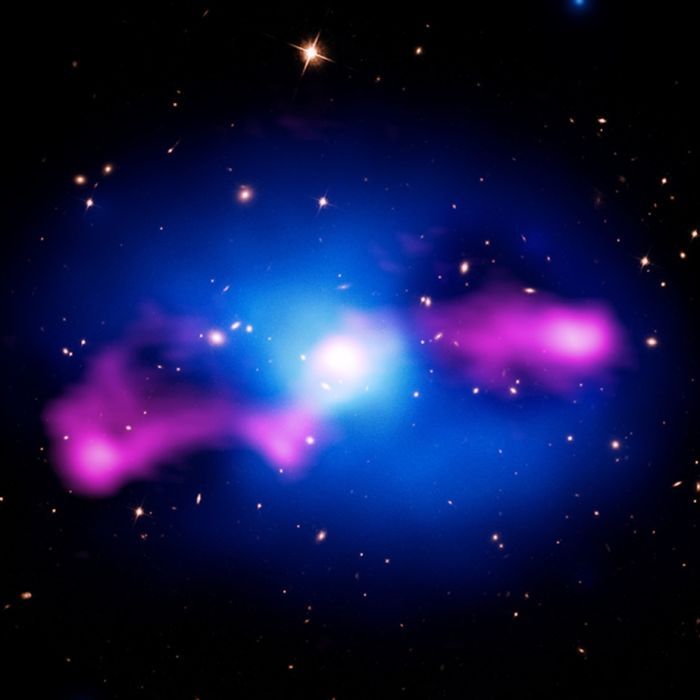
Astronomers capture an image of the continuing eruption of the most powerful explosion since the big bang.


