

A Nobel Prize winning biologist has ignited controversy after publishing details of an experiment in which a fragment of DNA appeared to ‘teleport’ or imprint itself between test tubes.
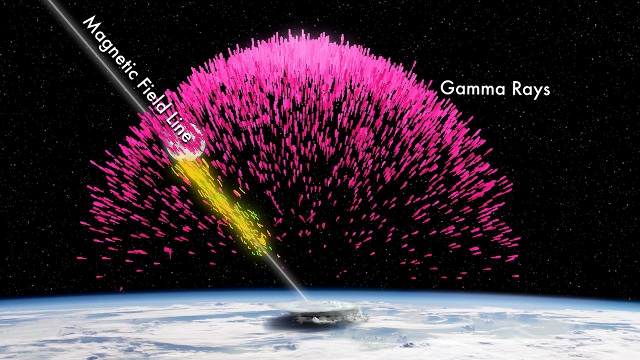
New observations from the Fermi space telescope have revealed that …

A new era of utilization for research and technology begins for the completed International Space Station. The orbiting laboratory shifts focus in 2011 from finalizing construction efforts to full-scale use of the facility for scientific investigation and technological advances.

In a groundbreaking achievement that could help scientists
Researchers have discovered Möbius symmetry in metamaterials -- materials engineered from artificial

The IceCube Neutrino Observatory, built over a decade at a cost of $271 million, is buried under the South Pole... and longer than the world

A leading American solar company is set to begin the largest residential rooftop project ever undertaken, effectively doubling the number of solar systems currently on homes around the U.S.

Google has been playing an interesting role in renewable energy development, and not only because it has invested more than $780 million in renewable energy generation and tech development.

What kind of technologies will evolve in the 2030s, and even the 2040s, to transform our fuel, food, and materials choices, and lead us towards some of the fuel targets outlined for 2050 by the International Energy Agency? In looking that far down the line, we have some long term trends to guide us.

PV - New Zealand commits to spend $6.7 million to fund first solar plant for Tonga - Renewable Energy Magazine, at the heart of clean energy journalism

PV - Cost of solar electricity to be halved by 2020 - Renewable Energy Magazine, at the heart of clean energy journalism


(PhysOrg.com) -- In an attempt to mimic the photosynthetic systems found in plants and some bacteria, scientists have taken a step toward developing an artificial light-harvesting system (LHS) that meets one of the crucial requirements for such systems: an approximately 100% energy transfer efficiency. Although high energy transfer efficiency is just one component of the development of a useful artificial LHS, the achievement could lead to clean solar-fuel technology that turns sunlight into chemical fuel.

Australia is taking its first leap into utility-scale solar PV with a 10-megawatt (MW) AC project located in Western Australia – 10 times larger than any operating project in the country.

Miscellaneous - India receives €200 million loan from EIB to fund renewable energy projects - Renewable Energy Magazine, at the heart of clean energy journalism


