
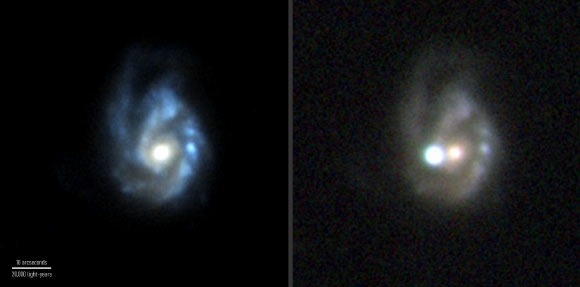
New gamma-ray observations from NASA’s Fermi Space Telescope suggest ultra-magnetic neutron stars called magnetars could be fueling superluminous supernovae.

Astronomers around the world are captivated by an unusually bright and long-lasting pulse of high-energy radiation that swept over Earth Sunday, Oct. 9. The emission came from a gamma-ray burst (GRB). Its cause is unknown.
Like a blinding beacon lighting up the night, a powerful gamma-ray-generating stellar husk has been seen pulsating in a neighboring galaxy.


