Disabled and elderly people could find it easier to navigate around town and city centers with a new hand-held computer being developed by a geographical information systems.

Sierra Nevada Corporation's (SNC) proposed Dream Chaser vehicle. It looks like a spacecraft ought to look. This is one of the key US commercial human spaceflight projects now in development.

Researchers have developed a curvilinear camera, much like the human eye, with the significant feature of a zoom capability, unlike the human eye. The


Scientists at the University of Massachusetts Lowell laugh in the face of Intel
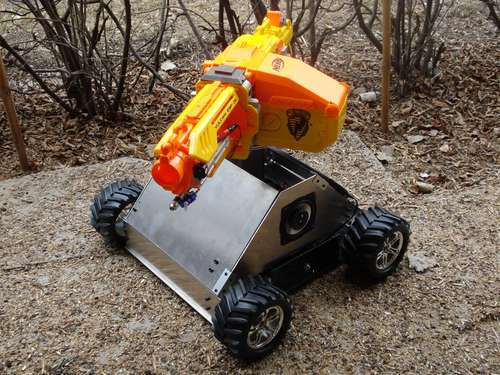
They walk, they dance, they...perform surgeries? Take a look at some of the best robotic creations of 2010!
Watson the super computer has defeated the two greatest human champs in the history of "Jeopardy."
(Medical Xpress) -- As the most common and deadliest form of cancer, lung cancer kills 1.4 million people per year worldwide, according to the World Health Organization. While current treatments may improve the survival rate when the cancer is caught in its early stages, the five-year survival rate for late-stage lung cancer can be less than 1%. Now some patients with advanced lung cancer may have another tool to combat the disease, as Cuban medical authorities announced on Tuesday that they will begin selling the world’s first therapeutic vaccine against lung cancer.


(PhysOrg.com) -- Although materials scientists have theorized for years that a form of super-dense aluminum exists under the extreme pressures found inside a planet’s core, no one had ever actually seen it. Until now.

(PhysOrg.com) -- An incredibly rare sub-atomic particle decay might not be quite as rare as previously predicted, say Cornell researchers. This discovery, culled from a vast data set at the Collider Detector at Fermilab (CDF), is a clue for physicists trying to catch glimpses of how the universe began.

Researchers have found a way to turn mouse embryonic stem cells into sperm. This finding opens up new avenues for infertility research and treatment.

No one likes a know-it-all but it turns out that a quantum know-it-all is the worst. New research has shown that the quantum world allows you to answer questions correctly when you don

The race to achieve ever-higher photovoltaic conversion ratios is, so to speak, a hot area of research. One line of research has focused on quantum dots – semiconductor nanocrystals under 2-10 nanometers (about 10-50 atoms) in diameter in which electron motion is confined in all three dimensions – as the fundamental elements of nanoscale solar cell technology.